
Mission Need
U.S. Customs and Border Protection (CBP) must secure U.S. borders while facilitating lawful trade and travel across more than 300 ports of entry. At land border crossings, officers inspect every vehicle, relying on pre‑primary data capture to focus attention on travelers as vehicles arrive. License plate recognition (LPR) is mission‑critical—reducing manual entry and providing officers and agents with timely, accurate plate data, images, and RFID reads prior to inspection. CBP’s Land Border Integration (LBI) team required a nationwide modernization to improve read rates, reliability, and adaptability while lowering technology ownership cost and accelerating innovation.
Solution
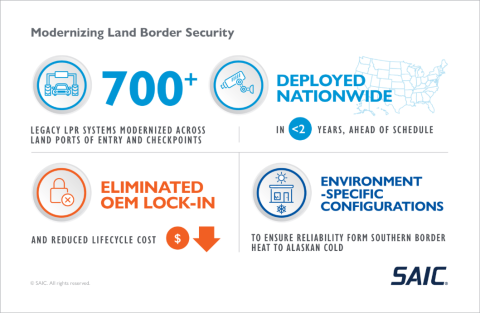
Click image to enlarge
Building on support to LBI since 2008 and responsibility for deploying and maintaining LPR systems across more than 100 of the busiest crossings and U.S. Border Patrol checkpoints, SAIC re‑architected the LPR solution to an open, platform‑independent design. Rather than treating “major capabilities” as a separate list, SAIC embedded them directly into the delivery approach:
- Open architecture and COTS-first design: Eliminated vendor lock‑in and enabled rapid integration of new technologies.
- Best‑of‑breed components: High‑speed cameras, advanced processors, and optimized enclosures to enhance performance and durability.
- Integrated subsystems: Tight integration of RFID with LPR and automated packaging of images/data to officer workstations prior to inspection.
- Environment‑aware configuration: Lane‑by‑lane tuning for lighting, angles, timing, and regional conditions—from extreme heat and insects at the southern border to subzero brittleness risks in Alaska.
- Reliability and safety improvements: Broader capture zones and non‑distracting illumination strategies to reduce blind spots and improve read consistency.
- Scalable deployment model: Pilot validation followed by nationwide rollout with standardized design and site‑specific adjustments.
Mission Impact
SAIC deployed the modernized LPR systems nationwide in under two years, ahead of schedule, meeting LBI’s performance and operational goals. Read rates exceeded CBP’s performance standard, and reliability gains reduced lane downtime. The open architecture lowered lifecycle cost, accelerated innovation, and improved adaptability to changing requirements. Officers benefit from higher‑quality pre‑primary data—front and rear plates, driver and scene images, and RFID—delivered to workstations before vehicles reach the booth, enabling more focused, efficient inspections and contributing to shorter wait times.
The SAIC-developed open architecture solution resulted in higher read rates, lower cost, and greater system adaptability for the agency.
Related Content
SAIC | Innovation at the Border
SAIC | 5 Governance Actions for Border Agencies to Maximize the Impact of AI