Mission Need
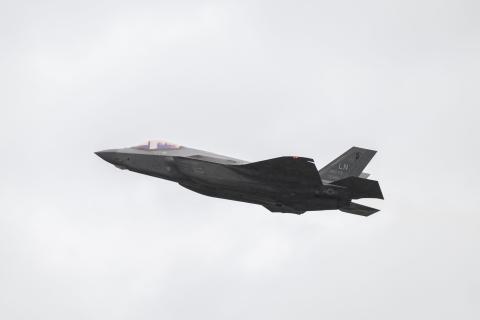
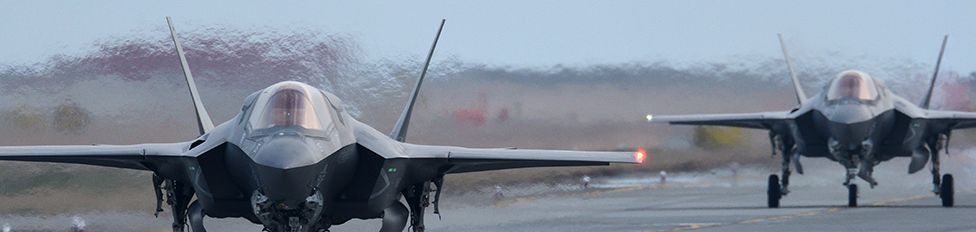
The F-35 is more than a fighter. It’s a highly advanced airborne sensor, a command and control (C2) node at the forward edge of the battlespace and a cornerstone of 21st-century air dominance. The US Air Force, alongside the US Navy and United States Marine Corps, is leading a renaissance in F-35 tactics, ushering in a new era of pilot training to match the aircraft’s advanced capabilities.
Training fighter pilots to operate in large, complex formations while interoperating across the joint force, is now essential to achieve mission success. Yet traditional approaches, from live-fly exercises to training in legacy simulator systems, fall well short of replicating the realities of modern combat. Live training with multiple aircraft is costly, logistically difficult, and constrained by airspace availability. As aircraft capabilities have evolved, traditional simulation exercises have not kept pace.
These challenges are even greater when preparing for allied coalition operations. The F-35 is required to sense across multiple domains, share exquisite data with allies and coalition partners, and provide essential combat capabilities to the Joint Force. Unfortunately, opportunities to train side by side with partners are significantly limited, slowing the development of seamless interoperability before real-world missions. The US Air Force needed a way to train F-35 pilots at scale and alongside coalition partners without the limits of geography or scheduling. It needed training that mirrored the complexity of real-world combat, preparing pilots not just to fly the F-35, but to fully harness its power as a force multiplier.
Solution
To meet this challenge, the US Air Force collaborated with SAIC to reimagine F-35 training in a more capable simulation environment. Together, they developed and deployed advanced simulation capabilities designed to break through the barriers associated with traditional training, and the result is significantly higher readiness levels.
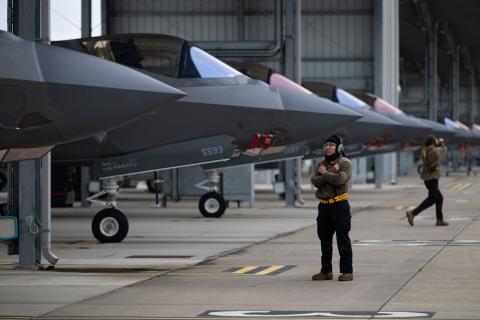
At RAF Lakenheath in the United Kingdom and the USAFE-AFAFRICA Warfare Center at Einsiedlerhof Air Station in Germany, SAIC helped deliver next-generation training solutions that bring the complexity of real-world missions into the virtual space. These environments allow pilots to train in larger formations than before—practicing advanced tactics and rehearsing missions in a multi-domain environment that builds decision-making skills in scenarios that look, feel and respond like live operations.
Repetition is key. With these new simulation tools, pilots now execute multiple missions per day in the force posture demanded by advanced F-35 tactics. The result is a significant increase in the pace of learning and combat capability, without the constraints of aircraft availability, limited flight hours or other real-world training limitations. The new simulators and simulation environments incorporate advancing threat systems and realistic adversary tactics, helping aircrews rapidly prepare for the dynamic challenges they will face in future conflicts.
Equally important, the new simulation platforms enable integrated training at scale with allies and coalition partners. Pilots from allied nations can now train together virtually, strengthening trust and improving communication and combat capability across entire theaters.
Mission Impact
The results are taking flight. At RAF Lakenheath, F-35 pilots report significant gains in mission readiness and tactical proficiency. Training events that once required weeks of coordination or were not even possible due to live-fly restrictions, can now be conducted whenever required and be repeated as often as needed. Warfighters now enter the cockpit better prepared, more confident, and more connected to their coalition partners.
Success in Europe is driving global expansion. The US Air Force is now adapting the training model for the Pacific theater, where vast distances, emerging threats and nations new to the F-35 present high priority challenges and opportunities. The same simulation-driven approach will allow US Air Force, US Navy, United States Marine Corps, allied and coalition pilots to train and rehearse F-35 missions together, greatly improving theater-wide combat capability.
This new era of training doesn’t just improve individual pilot skills. It transforms force readiness. Warfighters now train for the realities of modern warfare: distributed operations, coalition and joint force interoperability, and highly agile C2. They learn not only to employ the F-35 as a fighter, but even more importantly to leverage it as a lethal warfighting center of gravity across the theater battlespace.
Making the difference is the US Air Force’s commitment to innovation and SAIC’s expertise in simulation and mission systems. Together, pilot training is being redefined. US, allied, and coalition warfighters are not just ready for the challenges of today —they’re prepared to Fly, Fight, and Win tomorrow.
Use of DoD Imagery does not imply endorsement by the U.S. Government.