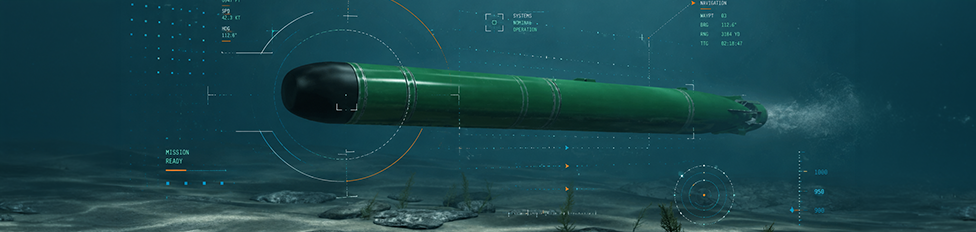
SAIC partnered with the U.S. Navy to restart production of the propulsion system for its heavyweight torpedo, the MK48, after more than two decades, rebuilding manufacturing capability and restoring the industrial base needed to support undersea warfare readiness.
Mission Need
U.S. Navy submarines operate globally as a critical element of national security, providing strategic deterrence and maritime presence. The MK48 heavyweight torpedo enables submarines to engage both undersea and surface threats in contested environments. As the Navy’s only submarine-launched weapon for both mission sets, the MK48 plays a central role in undersea dominance.
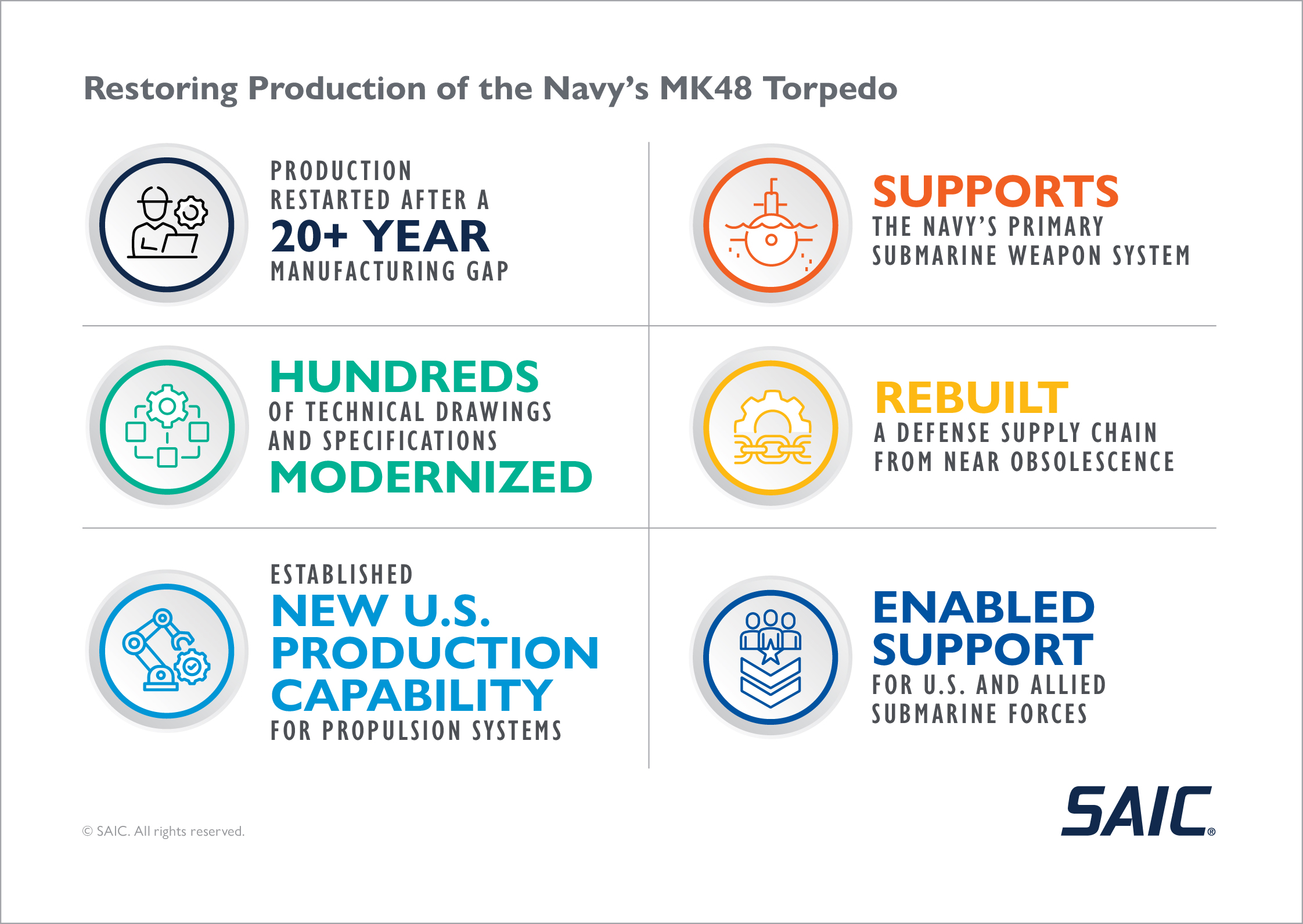
After the last MK48 torpedo was delivered in 1996, production stopped and the Navy relied on existing inventory for nearly two decades. As global threats evolved and operational demands increased, the Navy identified the need to restart production to ensure submarines remain equipped to meet future mission requirements.
Restarting production after more than 20 years presented significant challenges. The original industrial base had largely disappeared, many suppliers were no longer in business, and specialized manufacturing expertise had been lost. Materials and components specified in legacy designs were no longer available due to changing regulations and shifts in commercial manufacturing.
In addition, the technical data used to build the system did not keep pace with modern engineering standards. To move forward, the Navy needed to restart manufacturing while also rebuilding the supply chain and modernizing the technical foundation required to sustain production.
Solution
In 2016, the Navy awarded SAIC a contract to restart production of the MK48 MOD 7 Afterbody and Tailcone, the propulsion, steering, and power generation section of the torpedo. Often described as the engine room of the weapon, this section is essential to overall performance.
SAIC worked closely with Navy program leadership and industry partners to restore the capability to manufacture this complex system. Serving as a key integrator, SAIC coordinated engineering, production, testing, and supplier engagement across the program.
The team began by evaluating legacy technical data and working with the Navy to update drawings and specifications to align with current engineering standards. At the same time, SAIC partnered with suppliers to rebuild the production supply chain and qualify new materials and manufacturing processes to replace obsolete components.
The propulsion section includes hundreds of individual parts across multiple subassemblies, each requiring precise integration and testing. SAIC invested in production infrastructure, test capabilities, and quality inspection tools to support long-term manufacturing.
Through continuous collaboration with the Navy and industry partners, SAIC helped reestablish a sustainable production capability for this key component of the MK48 torpedo.
"Restoring production of the MK48 propulsion system was critical to ensuring the Navy’s submarine force remains ready to meet evolving threats."
— Capt. Nick Meyers
Mission Impact
Click image to enlarge
By restoring production capability, SAIC is helping the Navy rebuild its inventory of MK48 torpedoes and sustain operational readiness for the U.S. submarine force.
The MK48 supports all classes of U.S. Navy submarines and is also deployed by allied navies, making it a foundational capability for both national defense and coalition operations.
The effort has strengthened the defense industrial base by reestablishing specialized manufacturing capabilities and rebuilding a supplier network capable of supporting long-term production of undersea weapons systems. These improvements reduce risk, improve supply chain resilience, and position the Navy to sustain this capability over time.
Today, the renewed production capability strengthens the maritime industrial base and ensures the Navy can sustain delivery of this essential weapon system to the Fleet, supporting readiness in contested environments and long-term mission success. This approach provides a model for addressing similar legacy system challenges across the defense industrial base.
Visualization created using artificial intelligence (AI).