Mission Need
For the first time in more than 50 years, NASA set out to send astronauts beyond low Earth orbit, operating at distances that delay real-time communications and could impact the margin of safety.
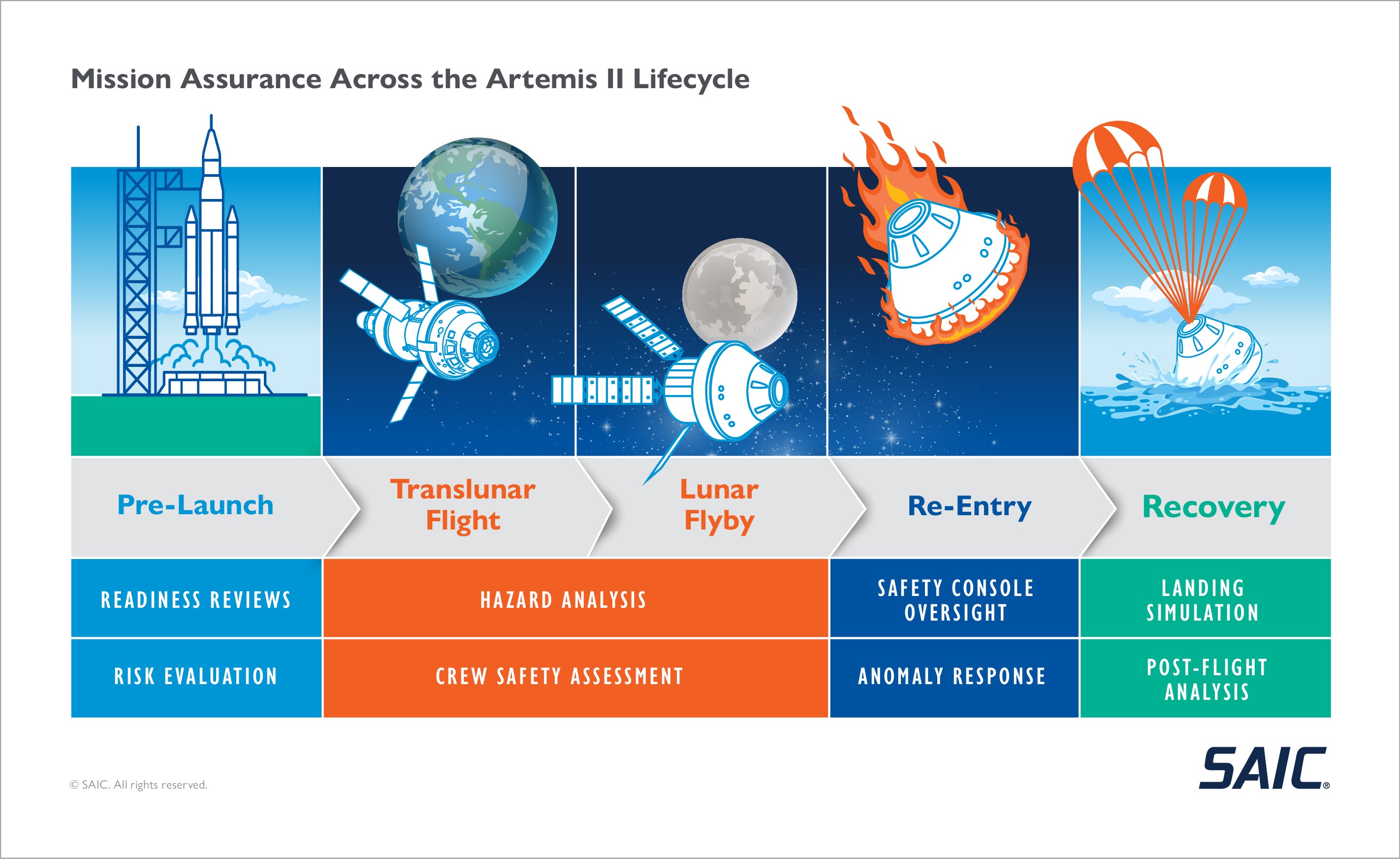
As the first crewed mission, Artemis II required mission systems such as life support and environmental control to perform under conditions not experienced by humans since the Apollo era.. As the crew traveled farther from Earth than any humans in history, even small issues had the potential to cascade across systems and mission phases. Unlike missions in low Earth orbit, deep space operations demand a higher level of confidence before launch. Systems must be evaluated not only on individual performance, but on how they interact across the full mission, from launch through translunar flight, lunar flyby, and re-entry and recovery.
Solution
NASA executed Artemis II with a focus on mission assurance across the full lifecycle, drawing on decades of experience in human spaceflight programs. SAIC supported these efforts by working alongside NASA teams to evaluate systems, assess risk, and provide mission expertise from early design through post-flight analysis.
Pre-Launch Readiness
- Reviewed system designs and evaluated hardware and software test data
- Supported inspection of flight hardware and certification of flight readiness
- Assessed performance across critical systems including the Space Launch System, Orion spacecraft, and Exploration Ground Systems
Integrated Risk Analysis
- Developed cross-program hazard analyses spanning multiple systems and mission phases
- Evaluated how risks could interact during key moments such as launch, translunar flight, and re-entry
- Identified potential failure points early to reduce risk before flight
Crew Safety Assurance
- Performed Crew Survival Analysis to evaluate astronaut safety capabilities
- Identified gaps and assessed residual risk across both nominal and contingency scenarios
- Focused on reducing risk to the crew under a range of mission conditions
Mission Execution Support
- Provided real-time mission expertise from the Safety Console in Johnson Space Center’s Mission Evaluation Room
- Monitored system performance and evaluated in-flight anomalies
- Supported root cause analysis and actions to maintain mission objectives and crew safety
Recovery and Post-Flight
- Developed landing and recovery simulation tools and conducted pathfinder studies
- Supported mission planning to enable safe crew recovery following re-entry
- Continued post-flight analysis to assess system performance and apply lessons learned to future missions
"SAIC brought the technical depth and mission focus we needed to evaluate integrated risks and support our teams across every phase of flight. Their contributions strengthened our mission assurance posture and gave us greater confidence as we work toward the next phase of lunar exploration.”
Mission Impact
Click image to enlarge
Artemis II demonstrated NASA’s ability to safely execute human spaceflight beyond low Earth orbit, completing a roughly 10-day mission that validated system performance across all phases of flight. By evaluating how systems operate together under real mission conditions and identifying how risks evolve across the mission lifecycle, SAIC helped NASA gain a clearer understanding of system behavior in deep space. This insight supports more informed decision-making, strengthens mission planning, and reduces uncertainty for future exploration efforts.
The mission also delivered critical performance data that will be used to refine systems, improve risk models, and increase confidence in future missions as NASA continues to work toward a sustainable human presence on the Moon.