
Civilian agency mission demands keep climbing, workforces are stretched thin, and budgets are flat or shrinking. With new AI and agentic capabilities offering the allure of rapid relief, many agencies are rushing to purchase. Yet they often discover that there’s no quick or simple path to value. That’s because AI adoption is vastly different from traditional technology procurements.
For years, agencies have focused on continuous modernization, investments aimed at making existing mission systems and processes work better. AI and agentic capabilities are different. Their promise is true transformation. They don’t just make a process faster or more efficient. They reshape the work itself, impacting the data, environments, and people that support it.
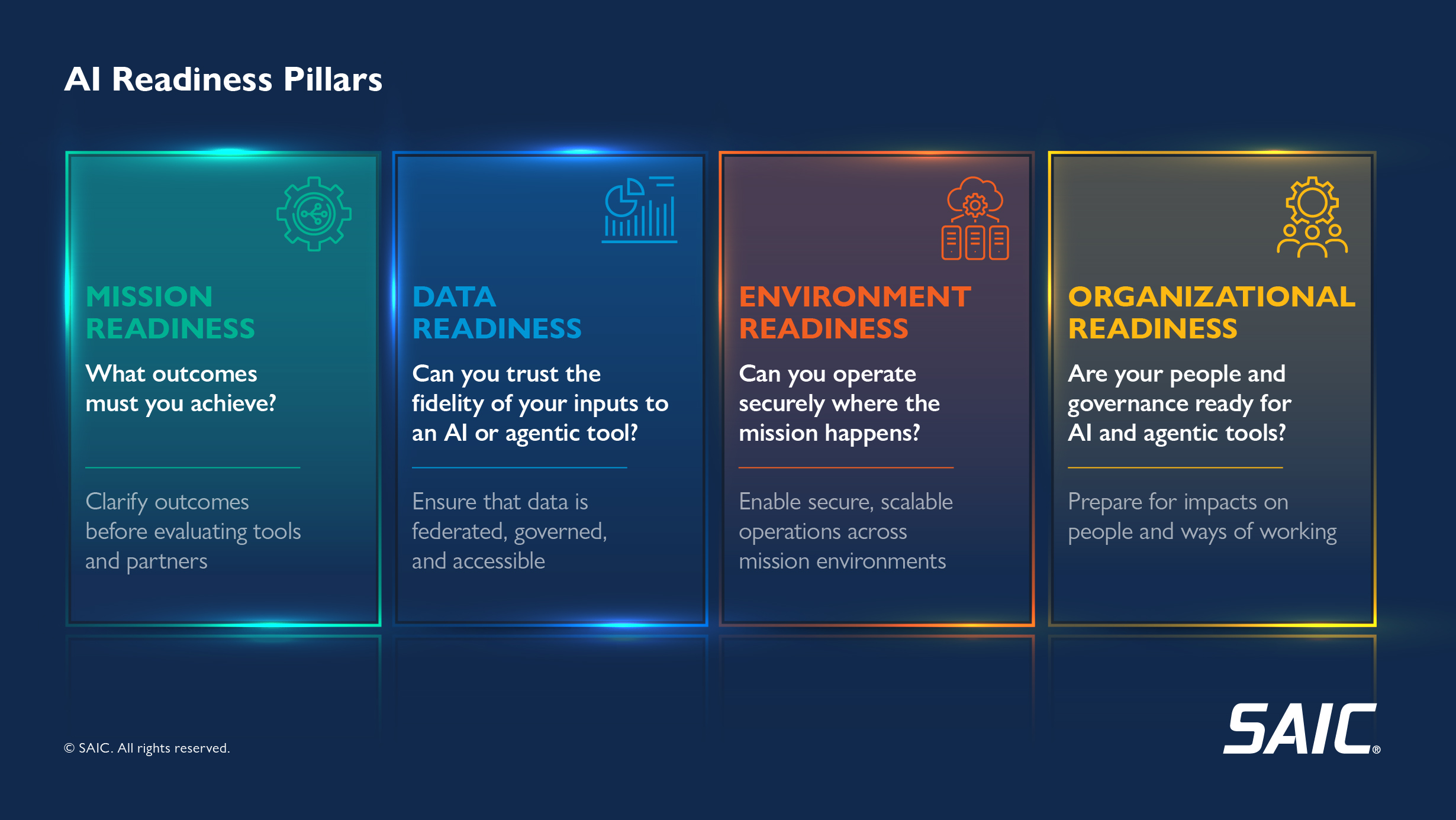
Figure 1. Four Pillars of AI and Agentic Readiness
Click image to enlarge
While that magnitude of change can deliver remarkable mission benefits, it can’t be achieved through technology procurement alone. The key to success lies in your agency’s readiness for AI and agentic capabilities. That readiness crosses the mission outcomes you’re pursuing, the data that powers decisions, the operating environment that connects it all, and the people responsible for delivering results. It’s the prerequisite for everything that comes after, and it comes down to four critical questions.
Mission Readiness: Outcomes > Tools
The optimal approach is to lead with the mission. Clearly define the outcome you need to achieve: eliminating a benefits backlog, resolving citizen calls on the first contact, or making eligibility determinations significantly faster. A claims-processing bottleneck and a gap in fraud detection are both important priorities, but they call for different capabilities.
Given the emphasis on tech innovations, agencies often decide they need AI before they articulate why. They may succeed in adopting a solution. They may even demonstrate some noteworthy outputs. But they aren’t likely to move the needle on an outcome that matters.
Let your target outcome decide whether AI is the right solution and, if so, what architecture and tools work best. When you lead with the mission, technology becomes a deliberate choice, and your subsequent data, environment, and governance decisions become easier to make.
Data Readiness: Trustworthy Inputs
Direct an AI system toward records that are inconsistent, untagged, outdated, or lacking context, and it will reflect those shortcomings back with fluency and confidence. Put simply, you can’t trust the output unless you trust the inputs.
Many civilian organizations have accumulated decades of data distributed across mission systems, applications, and organizational boundaries. Data readiness is about ensuring that information is discoverable, governed, trusted, and accessible when needed. Modern approaches focus on organizing data around domains, preserving lineage, and establishing shared meaning through semantic models. Those efforts are critical to ensuring that the right data reaches the right people, systems, and AI capabilities at the right time.
When implemented effectively, data readiness enables both humans and machines to move from raw data to actionable knowledge while maintaining trust in the information that drives decisions.
Environment Readiness: Secure Operations at Mission Scale
Even when the right data exists, mission value can’t be realized if information, AI capabilities, and mission workflows aren’t operating across the environments where the mission occurs.
Civilian agencies seldom operate within a single environment. Data, users, applications, and mission processes span cloud, on-premises infrastructure, edge locations, partner networks, and varying security domains. Environment readiness is the ability to securely connect and operationalize resources across those boundaries while maintaining performance, resilience, security, and governance.
Environment readiness provides the operational foundation that allows trusted data, AI insights, and agentic capabilities to move beyond pilots and into mission execution. Agencies that can securely operate across environments are better positioned to scale successful capabilities, adapt to changing mission needs, and realize value from AI investments more quickly.
Organizational Readiness: People and Governance First
More than technology or data, people determine the success or failure of large-scale transformation. If an agency workforce doesn’t understand a new capability, they won’t adopt it. And if they fear the new capability, they’ll resist it.
Organizational readiness requires preparing the agency workforce long before the first tool arrives. It also requires candor about how roles and workflow will likely change and how these changes will affect necessary skills.
The other half is governance: technical, setting guardrails for where AI runs, what it can touch, and what it costs to operate, and organizational, formalizing decision-making aligned to the target outcomes and policy guiding how far the agency will scale to achieve them.
In the context of AI and agentic readiness, governance should be viewed as more than a control for slowing things down. It’s the structure for making tech decisions aligned to mission outcomes and moving forward with transparency, speed, and confidence.
From Assistants to Agents
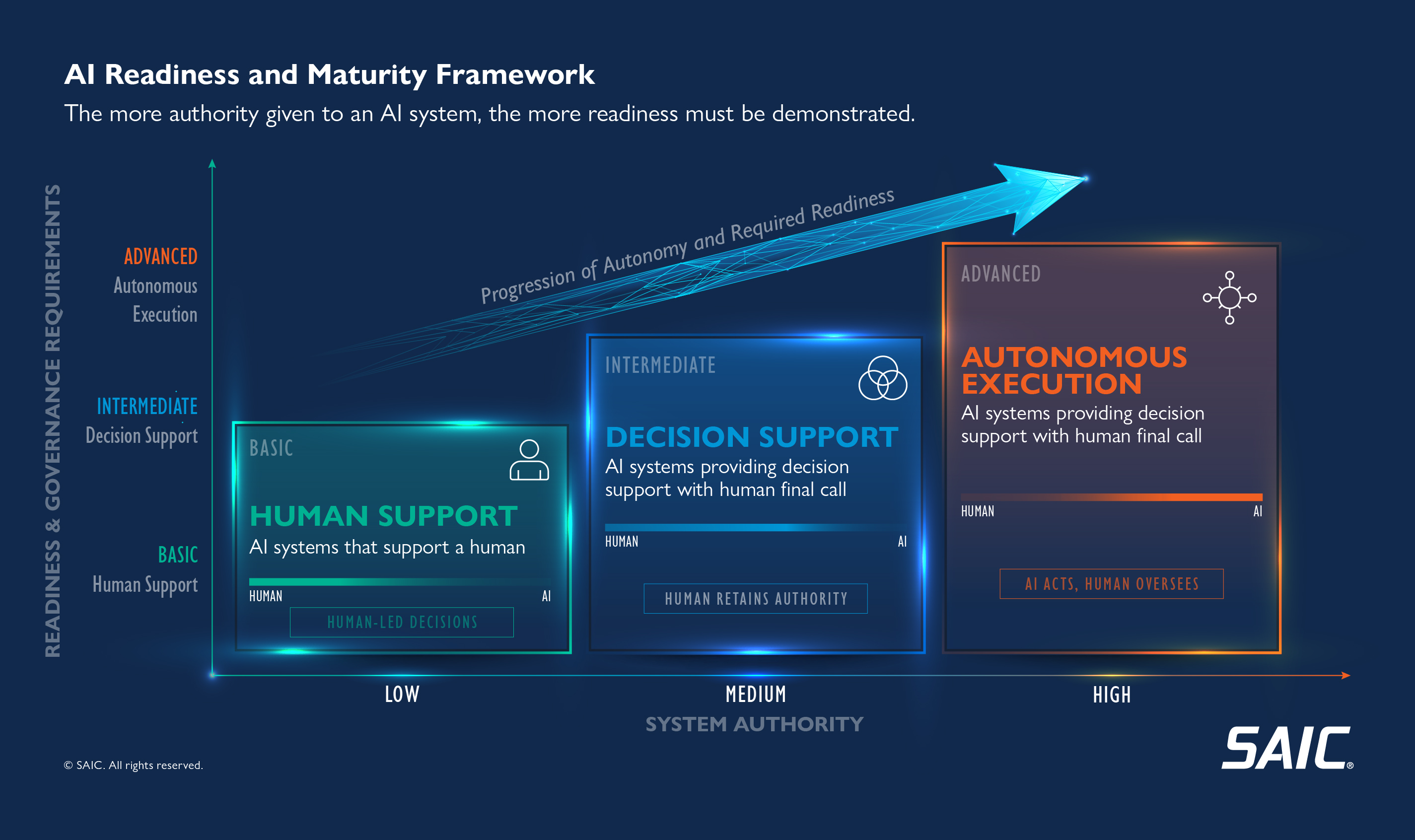
Figure 2. Readiness Maturity
Click image to enlarge
Today’s AI tools mostly function as assistants, serving up drafts or recommendations while a human makes the final decision and acts. The trajectory points toward AI systems that can do much more, including evaluating options and coordinating authorized processes on an agency’s behalf.
The more authority an agency delegates to these systems, the more its data quality, governance clarity, and operational readiness determine the trustworthiness of the results. Agentic capabilities require trusted data, clear guardrails, and environments that allow systems to securely access information, coordinate actions across systems, and operate consistently at scale.
The Mission is the Map
Despite what hype and headlines may suggest, AI is not always the answer. Some mission problems require the deterministic precision that traditional software delivers. There’s great value in knowing where AI belongs and where proven, rules-based approaches still serve your agency better.
When you determine that AI or agentic capabilities are the best choice, don’t rush to implementation. Handing your data, decisions, and institutional knowledge to a closed platform may position you for a fast start. But you might also inherit a permanent dependency on the platform provider.
By focusing on readiness across mission, data, environment, people, and governance, you can own your outcomes, retain control of your data, and understand agentic systems well enough to direct them.
Where Readiness Begins
The path to a real outcome runs through disciplined discovery and experimentation, anchored by a clear destination and the willingness to iterate toward it. Consequently, the most useful first move is also the simplest: Name your mission outcome.
That answer will provide clarity across decisions involving data, operating environments, governance, workforce priorities, and technology choices. Ultimately, it will enable your agency to adopt AI in ways that meaningfully improve outcomes for the people you serve.
Take the Next Step Toward AI Readiness Download the Infographic
Executive Summary
Take the AI Readiness Framework With You
Get the key takeaways on the four readiness pillars and how requirements evolve as AI gains greater autonomy.
About the Authors:

Dave Barber 
Vice President & Market Leader, Finance & Commerce
Dave Barber is Vice President & Market Leader of Finance & Commerce at SAIC, where he leads strategy and growth across key civilian agencies, including the Departments of Treasury, Commerce, Education, and Agriculture. Drawing on more than 30 years of experience in cloud modernization and digital transformation, he helps agencies modernize through secure multi-cloud, AI, and data-driven technologies that strengthen mission delivery.

Max Thompson
Product Portfolio Lead, AI, Data & Digital Engineering Products