
War Secretary Pete Hegseth’s recent memo for senior Pentagon leadership is ushering in a new era of acquisition reform for the military. The memo announces sweeping changes to address systemic challenges to faster acquisition. It emphasizes speed to capability delivery to warfighters as the decisive factor for deterrence and military superiority.
91% of defense and intelligence leaders say that accelerating the acquisition process is important to innovate for mission success.
Source: SAIC 2025 U.S. Federal Leaders Mission Integration Survey
Among other guidance, the memo addresses modernizing contracts, restoring the warrior ethos across the acquisition workforce and establishing portfolio scorecards and performance measures to track progress. This new direction is more than a call for faster acquisitions. It is a call for a new breed of partnership between the military and industry with commercial innovation and speed at the core.
As national security organizations turn to industry for rapid innovation to maintain military superiority, mission integrators play a critical role. Integration is what transforms innovation into the operational capabilities that warfighters require for combat readiness.
Leaders Identify Top Innovation Barriers
National security agencies are not designed, funded or prepared to navigate the everchanging landscape of emerging technologies and commercial innovation. In fact, they face significant headwinds when it comes to driving innovation themselves.
According to an SAIC survey, defense and intelligence leaders most often ranked rapid technology change as the top external challenge to mission success. These leaders also identified their biggest challenges to innovating to advance warfighting capability (Figure 1).
Figure 1: Innovation challenges for defense and intelligence organizations to drive mission success
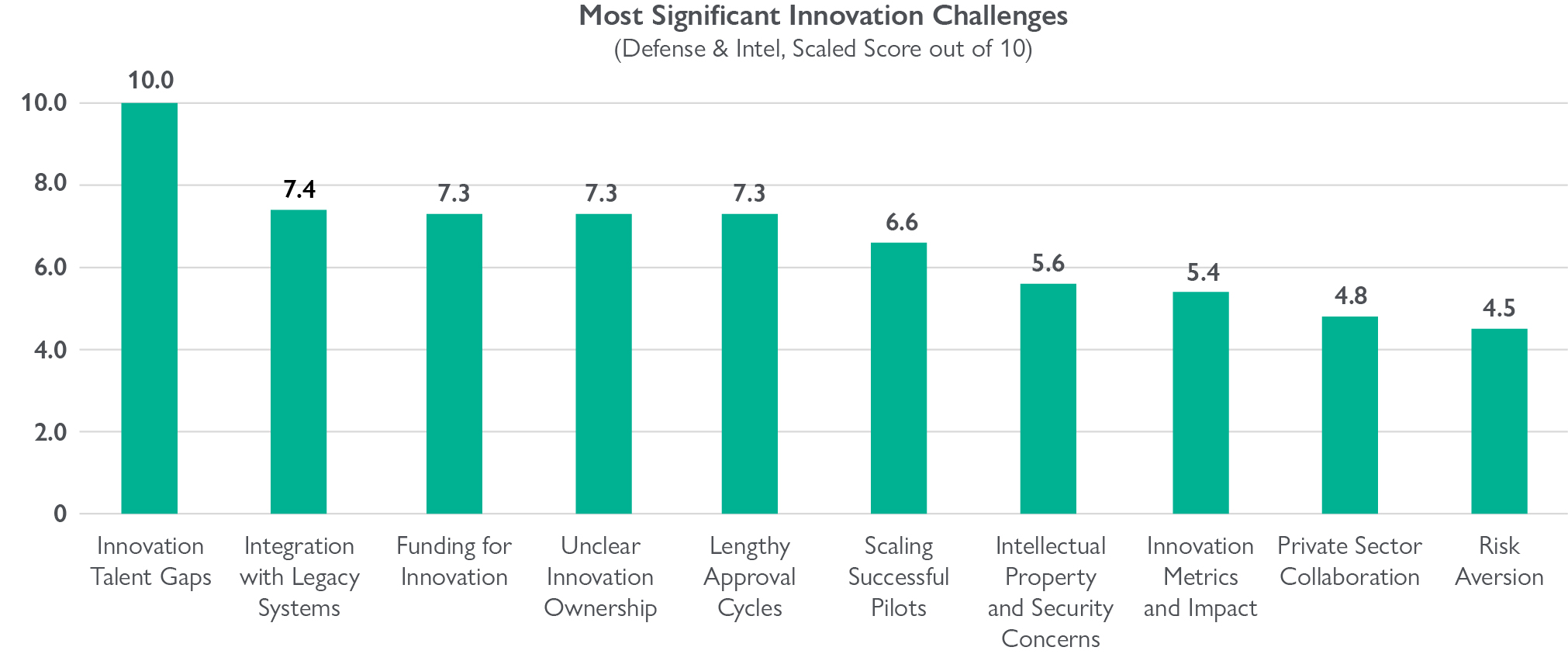
The survey responses show that innovation talent gaps is the top challenge, followed by integration with legacy systems. Funding for innovation, unclear innovation ownership and lengthy approval cycles—all of which are addressed in Secretary Hegseth’s memo—tie for third place.
While innovation talent gaps is a clear outlier, the other nine challenges cluster closely together. This compressed spread signals that defense and intelligence organizations face multiple, comparable hurdles rather than a few dominant issues in innovation. The challenges are equally significant and span the innovation lifecycle, which points to a need for comprehensive solutions over targeted fixes.
Converting Innovation Into Combat Power
Breakthrough innovation increasingly comes from academia, tech giants and startups backed by private capital in a system that moves faster than traditional acquisition cycles.
The memo’s emphasis on harnessing commercial innovation to address the nation’s most pressing national security challenges is a clear recognition of a challenging innovation environment.
However, as the Department of War acquires commercial products and technologies under this new guidance, the critical challenge will be orchestrating disparate commercial technologies into unified operational capabilities. This makes integration critical; it transforms innovation into combat power.
In this environment, mission integration is especially critical. It bridges the gap between commercial innovation and warfighting. Mission integration is proactive problem solving that makes funding go further, not consulting or reselling. It combines current systems, emerging technologies and best-in-class commercial solutions into a unified, mission-ready “system of systems.” Critical capabilities work together rapidly, securely and at scale to deliver capability to warfighters.
Mission integration can help the military optimize commercial innovation in four important ways:
Accelerated execution for joint warfighting readiness. Mission integration supports increased speed and agility in responding to the rapidly changing threat landscape by design. The combination of an outside-in perspective, model-based systems engineering practices and modular, agile solutions shrinks long pilot-to-deployment timelines. With open architecture solutions, agencies aren’t beholden to proprietary systems and upgrades are faster.
Closing all-domain kill chains at near machine speed and providing U.S. and coalition forces with unparalleled decision dominance requires seamlessly linking fleets of globally-networked sensors, lethal platforms and C2 systems. SAIC’s combat-tested communications and data backbone, Joint Range Extension (JRE), enables U.S. forces and allied air, ground and maritime platforms to collect and exchange vast amounts of tactical data in real-time. Created in the operating system-agnostic Java programming language, JRE integrates easily into existing architectures and future platforms.
Orchestration of the industrial innovation ecosystem. Mission integrators are natural ecosystem orchestrators that help national security organizations overcome bottlenecks and maximize the potential of commercial innovation and dual-use technology to support warfighters, allies and partners. They work with venture capital and all types of companies, from hyperscalers to niche startups that can lack the capabilities to integrate, scale and secure their innovations to be ready-now for classified environments and warfighting operations.
As a mission integrator, SAIC participated in an important international exercise testing unmanned underwater vehicle (UUVs) in an operational environment. Working with VATN, a startup that builds affordable UUVs at scale, and Invisible, a commercial AI partner, we demonstrated effective, collaborative UUV swarms. The solution includes an autonomous command and control system that uses adaptive AI. This system can operate independently providing undersea diversion, persistent underwater surveillance or decoy, or within the fleet without disrupting its design.
Specialized understanding of military operations and classified environments. For commercial innovation to be military-ready, it must align with the complexities of the military environment. Mission integrators develop technology solutions through this lens. In addition, they have the knowledge to quickly bring together existing military technologies and commercial solutions, evaluating their applicability and impact on behalf of a workforce that may not have this expertise.
The Department of War relies on software to support mission-critical operations across all domains. Yet traditional software delivery methods often have fragmented, slow and complex processes. Collaborating with Defense Unicorns, SAIC integrated the company’s Unicorn Delivery Service (UDS) into our existing, robust software delivery ecosystem. This streamlined how we deploy and maintain applications across cloud, on-premises and tactical edge environments—improving operational readiness for warfighters. Software teams can field mission ready applications more efficiently and cut delivery timelines from months to weeks or days. Mission owners can build once and deploy anywhere because the platform delivers containerized solutions securely to cloud or edge.
Capability optimization beyond deployment. While mission integrators excel at ensuring that technologies work together securely, efficiently and rapidly, they also focus on what must happen after the implementation for sustained success. This assistance helps military organizations close innovation talent gaps by educating the workforce on how to evolve to optimize the system lifecycle.
Sustainment engineering activities typically represent the longest-lasting phase and generate the highest total cost for any platform or system. But SAIC is exploring how AI can help optimize designs for better long-term performance and cost efficiency. AI-powered predictive maintenance can maximize operational availability, and AI-enabled performance optimization ensures that systems operate within their design envelope for mission success. Moving toward AI-driven maintenance and analysis makes it more possible to shift from reactive to predictive maintenance models.
Rapid Innovation to Overmatch Adversaries
Defense acquisition reform is an opportunity for both the Department of War and industry. Mission integration translates this shift into capability with urgency. By shedding bureaucracy to speed continuous innovation, national security agencies and mission integrators can work together to strengthen and sustain the U.S. military’s combat readiness.
LEARN HOW SAIC TURNS MISSION INTEGRATION INTO MISSION IMPACT
About the Author

BOB RITCHIE is the Chief Technology Officer at SAIC, overseeing the company’s technology strategy, roadmap integration and technical excellence. Since joining SAIC in 2005, he has led major modernization efforts for DOD systems, driven enterprise-wide DevSecOps and cloud initiatives, and served as CTO of the SAIC Innovation Factory. Ritchie also brings industry experience from Capital One’s cloud transformation. He holds multiple agile, DevSecOps and cloud certifications, and serves on several advisory boards, including Zscaler and Xage. He was named to Washington Business Journal’s 40 Under 40 and is a two-time finalist for WashingtonExec’s Cloud Executive of the Year. Ritchie holds a B.S. in Computer Engineering from Virginia Tech. robert.d.ritchie@saic.com
About the SAIC 2025 U.S. Federal Leaders Mission Integration Survey
SAIC surveyed 153 respondents from the U.S. Armed Forces and federal government agencies to understand the perspectives of federal defense, intelligence and civilian leaders on the implementation, challenges and potential of mission integration. Respondents are senior leaders who lead, manage and make decisions regarding people, programs, infrastructure and mission activities, and are responsible for mission outcomes. The online survey was conducted by Market Strategy Group between May 9, 2025 and May 22, 2025.